Richmond Real Estate Market Update March 2026 | What Sellers Need to Know
There’s a big difference between a market that is falling apart and a market that is simply forcing people to be more realistic.
Right now, Richmond real estate is the latter.
After a softer stretch through late 2025 and into the early part of this year, March 2026 brought one of the more encouraging signs we’ve seen in a while. Sales activity in Richmond increased 46% month over month, which suggests that buyers are not gone, not waiting forever, and not completely on the sidelines.
But they are selective.
And that distinction matters.
Because while the market is showing more life, it is also exposing a growing gap between homes that are properly positioned and homes that are still being brought to market with pricing, presentation, or expectations that belong to a different year.
That’s really the story right now.
Not panic.
Not boom times.
Not collapse.
Not a full rebound either.
Instead, we are seeing a market that is becoming more rational, more segmented, and, frankly, less forgiving.
For sellers, that means strategy matters more.
For buyers, it means opportunity still exists.
And for homeowners simply trying to make sense of what they’re hearing, it means the truth is a lot more nuanced than the headlines.
The Richmond Market Is Improving, But Not Evenly
One of the easiest mistakes to make in real estate is to talk about “the market” as if it behaves the same way everywhere and across every price point.
It doesn’t.
And right now, that matters more than ever.
Because Richmond is not one market.
It is a collection of micro-markets shaped by:
property type
location
school catchment
price range
condition
lot value
redevelopment potential
and increasingly, buyer psychology
That’s why one seller can feel like the market is dead, while another gets strong showings and serious interest in the first week.
Both can be true at the same time.
The broad numbers still matter, but they only tell part of the story.
The more important question is:
Which part of the market are you actually in?
That is where good strategy starts.
What the March Numbers Are Telling Us
At a high level, March 2026 gave us a market that is more active than January and February, but still far from aggressive.
Here are the main takeaways:
Sales improved meaningfully from the previous month
Inventory remains elevated
Prices are still down year over year
Detached homes remain the weakest segment
Townhomes and condos are holding up somewhat better
Buyers are active, but they are still value-conscious and cautious
That combination creates a market where momentum is returning, but not in a way that lifts everything equally.
And that’s where a lot of homeowners get tripped up.
Because activity alone does not automatically mean pricing power.
A market can become more active while remaining price-sensitive.
That is exactly what we are seeing right now.
The Detached Market Is Still the Most Challenging Segment
If you are selling a detached home in Richmond, this is still the part of the market where sellers need to be the most disciplined.
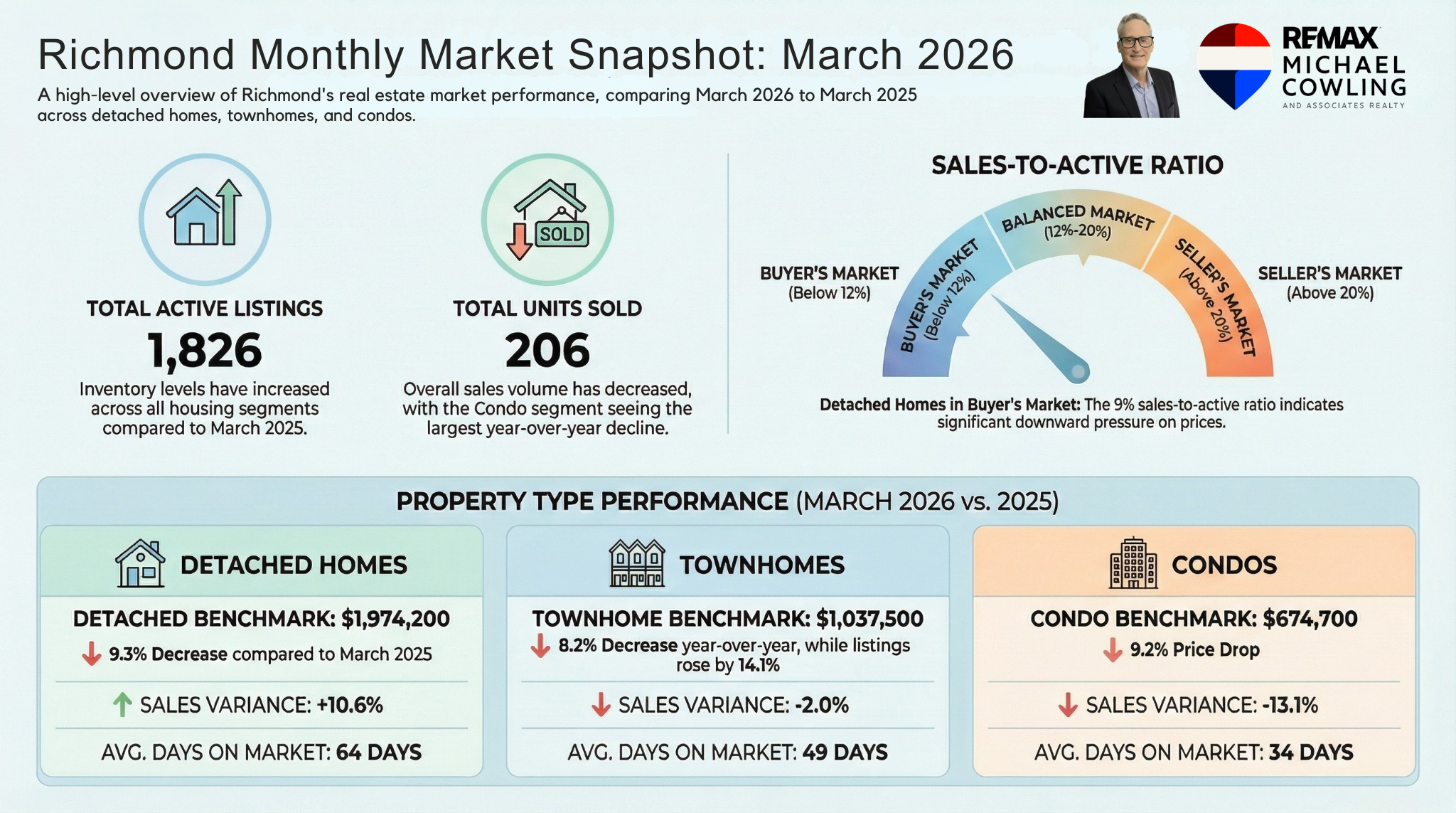
As of March 2026:
Benchmark price: $1,974,200
Year-over-year change: -9.3%
Sales-to-active ratio: 10.6%
Average days on market: 64
Total active listings: 576
Sales: 52
That 8.6% sales-to-active ratio is an important number.
In plain English, it tells us there is still more detached inventory available than there is demand to absorb it quickly.
That does not mean detached homes are not selling.
They absolutely are.
But it does mean detached sellers are no longer being rescued by broad market momentum.
In a stronger market, a home can be slightly overpriced, slightly underprepared, or slightly unclear in its positioning and still get carried along by urgency.
That is not happening as reliably right now.
Today’s detached market is exposing homes that are:
priced based on last year’s assumptions
marketed too casually
relying too heavily on “someone will love it.”
or ignoring what buyers are actually comparing them against
That’s why some homes are sitting while others still move.
The market is not saying “no” to everything.
It is saying “prove the value.”
And that is a very different environment.
This Is a Market That Punishes Overpricing Quickly
If I had to point to the single biggest issue hurting sellers right now, it would be this:
Too many homeowners still believe they can “test the market.”
That strategy is much riskier than it sounds.
Because in a market like this, buyers are not passively discovering listings one at a time.
They are actively comparing everything.
They are looking at:
What sold last month
What is still sitting
What got reduced
What feels sharper
What offers more value at the same price
And if your home misses that value equation early, you often lose your best window of attention.
That’s the part sellers tend to underestimate.
The first 7 to 14 days still matter enormously.
That is when:
Your listing is freshest
Buyers are most curious
agents are most likely to show it
and the market gives you the benefit of the doubt
Once a property starts sitting too long, it often enters a different phase psychologically.
Buyers begin asking:
Why hasn’t it sold?
What am I missing?
Is there a problem?
Will they reduce?
That’s when sellers often end up chasing the market instead of leading it.
And once that happens, the final sale price is often lower than if they had simply started in the right place.
Townhomes and Condos Are Holding Up Better Than Many People Realize
While detached homes are still under more pressure, townhomes and condos are showing better relative balance.
That doesn’t mean they are “hot,” but they are behaving differently.
Richmond Townhomes – March 2026
Benchmark price: $1,037,500
Year-over-year change: -8.2%
Sales-to-active ratio: -2.0%
Average days on market:49
Total active listings: 340
Sales: 48
Richmond Condos – March 2026
Benchmark price: $674,700
Year-over-year change: -9.2%
Sales-to-active ratio: -13.1%
Average days on market: 34
Total active listings: 910
Sales: 106
That tells us a few important things.
First, there is still meaningful demand in the strata market, especially where properties are:
well located
move-in ready
priced realistically
and suited to first-time buyers, downsizers, or move-up households
Second, this is creating a more interesting environment for move-up buyers.
One of the quieter opportunities in this market is the way the price gap between property types has shifted.
If detached values soften more than townhome or condo values, the move from one category to the next can become more affordable in relative terms.
That means some homeowners who felt “stuck” a year or two ago may actually have more flexibility now than they realize.
And in a market like this, relative value matters just as much as headline pricing.
Richmond Is Not Behaving the Same Way Across Neighborhoods
This is where broad market reporting starts to fall short.
Because even within Richmond, not all areas are seeing the same level of correction, resistance, or buyer confidence.
And that’s exactly why sellers should be cautious about relying too heavily on generic city-wide averages.
Steveston: Still Strong, But Not Untouchable
Steveston remains one of the most desirable pockets in Richmond for all the reasons it always has been:
established community feel
strong schools
walkability
family appeal
and a lifestyle component, buyers continue to value
That long-term demand has not disappeared.
But even Steveston is still navigating the broader market adjustment.
Detached values in Steveston Village and Steveston South have softened alongside the wider detached segment, with meaningful downward adjustment over the past year.
That said, the homes still performing best tend to share the same traits:
strong micro-location
practical family layout
updated or well-maintained condition
realistic pricing
good school catchment
And that’s an important reminder.
Even in softer markets, quality still attracts demand.
In fact, softer markets often make quality stand out more.
Because when buyers have more choice, they become even more intentional about where they are willing to stretch.
Terra Nova and West Richmond: Higher-End Buyers Are Still Active, But Unforgiving
Luxury and upper-end neighborhoods like Terra Nova continue to hold up better than some other detached segments.
Detached benchmark values in Terra Nova are hovering around $2,280,000, which is down from the peak but still showing a more modest correction than some other Richmond areas.
But this part of the market comes with its own challenge:
Higher-end buyers are very sensitive to stale listings.
They are often:
more analytical
less rushed
less emotional in their timing
and highly aware of competing options
That means homes priced above market in these areas can lose momentum quickly.
In the upper brackets, “just trying a number” can be expensive.
And sellers who insist on treating the market as aspirational instead of competitive often end up paying for that delay later.
Ladner and Tsawwassen Are Still Offering a Value Story
One of the more interesting local themes right now is the continued appeal of South Delta as a value alternative.
With benchmark pricing around:
Ladner:$1,075,800
Tsawwassen:$1,138,000
…buyers who feel priced out of Richmond are still looking closely at these areas.
And understandably so.
For many households, South Delta still offers:
more lot size
more space
quieter neighborhoods
strong family appeal
and in some cases, better relative value
That makes Ladner and Tsawwassen especially relevant for:
move-up buyers
young families
downsizers wanting more flexibility
Richmond sellers looking to reposition their equity
That said, South Delta sellers still need to respect the current environment.
Buyers are not reckless there either.
They are still comparing, still negotiating, and still expecting value.
So while the appeal is real, the strategy still matters.
Buyers Still Have an Opportunity Here
For buyers, this remains a healthier market than what we saw during the more compressed years.
And that’s worth saying clearly.
Because while a lot of public commentary still focuses on uncertainty, many serious buyers are actually finding this to be a much more workable environment.
Why?
Because they have something they were missing for a while:
breathing room
That means buyers often have more ability to:
include financing subjects
complete inspections
Review documents carefully
Compare inventory without panic
negotiate on price or terms
That does not mean every property is negotiable or every seller is vulnerable.
But it does mean buyers are operating in a market that allows for more thoughtful decisions.
And in many cases, that is exactly when the best purchases happen.
Not when the headlines feel safest.
But when the conditions are quietly more favorable than most people realize.
What I Think Sellers Should Really Take Away From This Market
If I were to boil March 2026 down into one message for homeowners, it would be this:
This market is still very workable, but only if you respect it.
That means respecting:
where buyers are today
How much choice do they have
How quickly does overpricing get exposed
And how much presentation and positioning now matter
Many sellers are still hoping the market will do the heavy lifting for them.
That is not the market we are in right now.
Today, results are being earned a little more deliberately.
And honestly, that is not a bad thing.
Because markets like this tend to reward:
preparation
realism
patience
and better decision-making
That’s not always easy to hear, but it usually leads to better outcomes.
My View: This Is a Smarter Market Than the One We Had Before
There’s a temptation in real estate to think every market needs to be either “amazing” or “terrible.”
The truth is, the best markets for decision-making are often somewhere in the middle.
And that is closer to what we are moving toward now.
Not a market driven by blind urgency.
Not a market where anything sells for any price.
But a market where:
pricing matters
Product quality matters
negotiation matters
local knowledge matters
And professional guidance still has real value
Personally, I think that’s healthier.
And for people making meaningful decisions, whether they are selling a long-time family home, moving up, downsizing, or relocating, healthier usually beats chaotic.
Final Thoughts
March 2026 did not “fix” the Richmond market.
But it did reinforce something important:
The market is still moving.
And in real estate, movement matters.
Buyers are active.
Homes are selling.
Good properties are still getting attention.
And smart sellers can still do very well.
But success right now is coming from clarity, not hope.
From pricing, not guessing.
From strategy, not assumptions.
That’s the real shift.
And for homeowners who understand that, there is still plenty of opportunity in this market.
Thinking About Selling in Richmond, Steveston, Ladner, or Tsawwassen?
If you’re wondering how today’s market applies to your home, your neighborhood, and your price range, I’d be happy to help.
Because while broad market stats are useful, the real strategy usually comes down to:
your location
Your property type
your condition
your timing
and what buyers are likely to compare you against right now
If you’d like a clearer picture of where your home fits in today’s market, feel free to reach out.
Get a Home Value Review
Find out what your home may be worth in today’s market and what strategy makes the most sense for your next move.
