Strategic Pricing to Avoid the 2026 BC Budget Luxury Tax Bracket
Bypassing the $3M Luxury Tax Bracket: The Seafair Assembly Strategy for Richmond Sellers
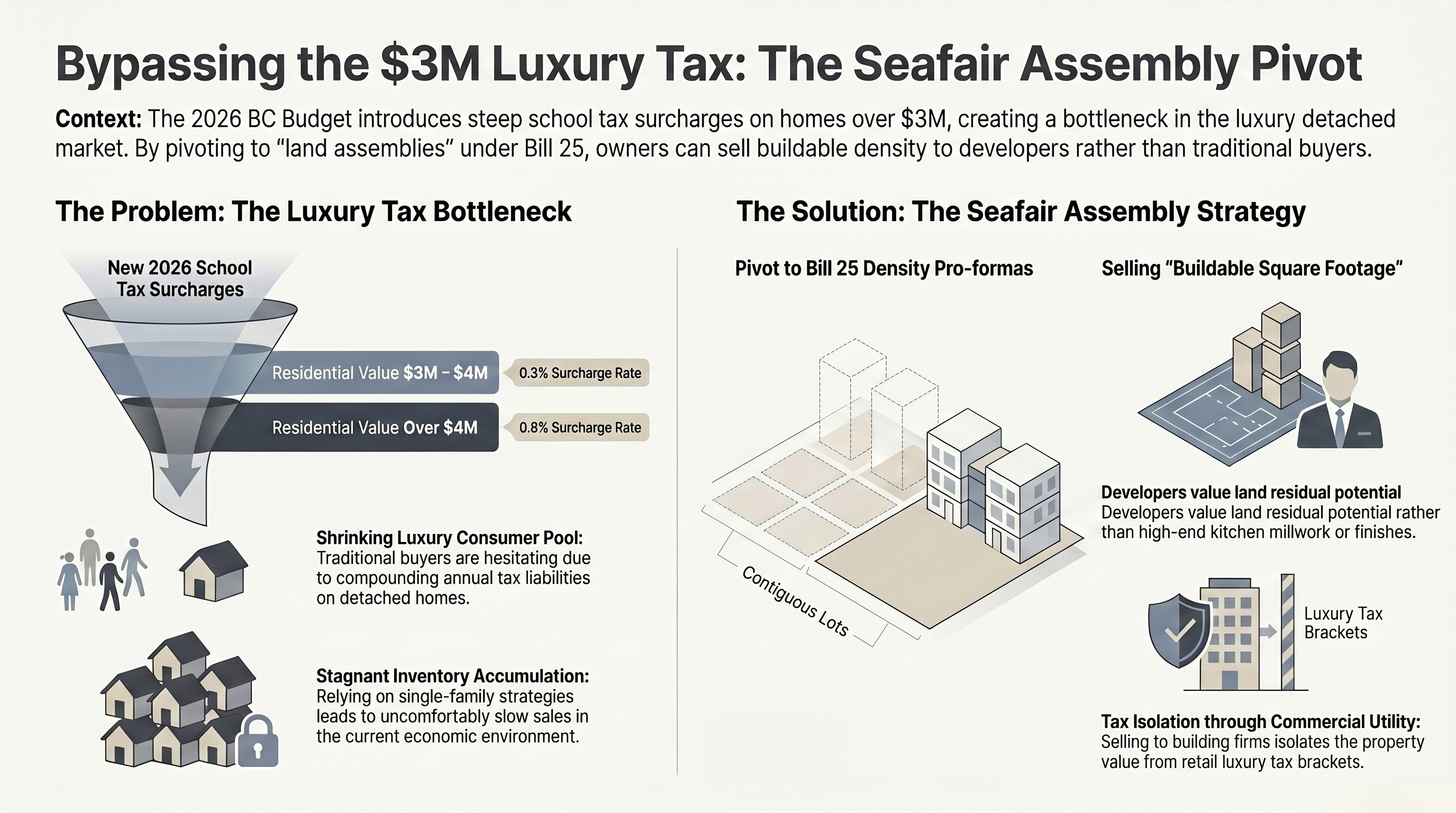
The luxury detached housing market in Greater Vancouver is adjusting to a brand-new economic environment. Following the presentation of the 2026 BC Budget, high-end homeowners face a steep increase in holding costs due to the newly restructured provincial tax rates. Specifically, the expansion of the additional school tax surcharges, bumping rates up to 0.3% on residential values between $3M and $4M, and to 0.6% on anything exceeding $4M, has introduced an unexpected obstacle for traditional luxury listings. If you are trying to market a premier property using yesterday's single-family strategies, you are likely to experience an uncomfortably slow sales process.
The Detached Inventory Bottleneck
As traditional luxury buyers hesitate in the face of these compounding annual tax liabilities, premium inventory is beginning to accumulate across West Richmond. Homeowners who rely entirely on finding a single-family buyer are discovering that the traditional upscale consumer pool is shrinking rapidly. To safeguard your wealth, you must change your target audience entirely.
With the 2026 BC Budget expanding school tax surcharges on homes valued over $3M, detached sellers face an inventory bottleneck. Michael Cowling uses Bill 25 density pro-formas to pivot properties away from the stagnant luxury consumer pool and into high-yielding Seafair land assemblies designed specifically for small-scale developers.
The Mechanics of the Pivot
By shifting your focus from private luxury buyers to active building firms, the $3M price ceiling is no longer a constraint. Developers do not evaluate a site based on its high-end kitchen millwork or premium interior finishings. Instead, they operate on a forward-looking, land-residual model driven by the site's total buildable square footage under Small-Scale Multi-Unit Housing (SSMUH) mandates.
When multiple contiguous lots are organized together into a single development footprint, project efficiency scales dramatically. A joint land assembly in neighborhoods like Seafair easily clears municipal lot-width hurdles, allowing builders to construct efficient, high-density 4-to-6-unit multiplex layouts. This structural approach shifts the value calculation directly in your favor:
Gross Realizable Value: Maximizing the total square footage a builder can legally build and sell.
Structural Efficiency: Combining lots eliminates redundant side-yard setbacks and shared underground service connections.
Tax Isolation: Developers buy raw buildable square footage based on commercial utility, completely isolating the sale from retail luxury tax brackets.
Protect Your Multi-Million-Dollar Equity
The real estate landscape has evolved, and backward-looking real estate appraisals are no longer sufficient to protect your multi-million-dollar equity. Navigating this dense regulatory and fiscal environment requires institutional-grade underwriting data. Don't let your wealth sit stagnant on an over-supplied retail market. Contact Michael Cowling today to secure a custom property density review and find out how a collaborative development play can unlock your site's maximum earning power.
