Navigating the June 30, 2026 Bill 25 Deadline in Broadmoor, Richmond
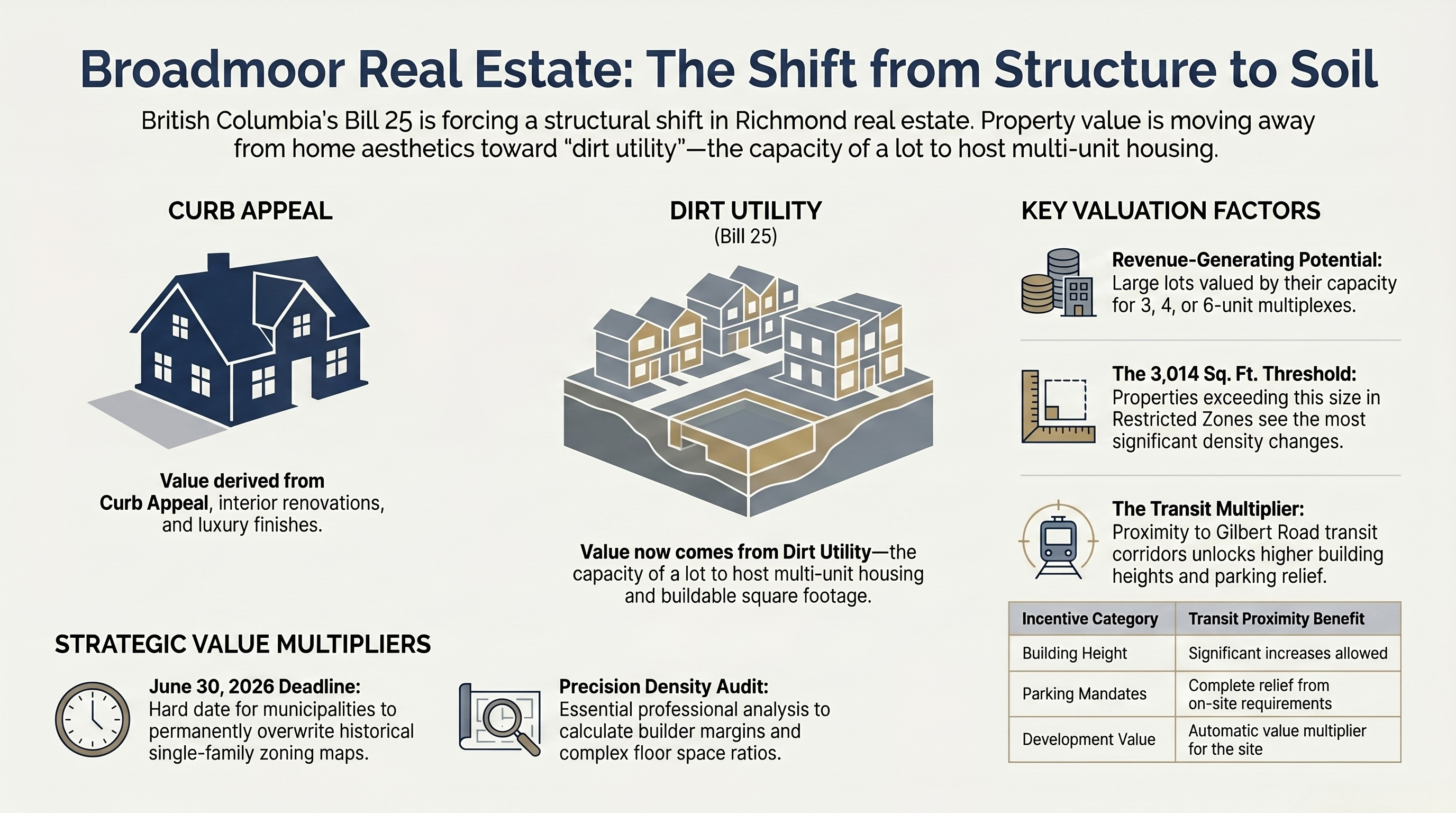
The traditional single-family real estate strategy in Richmond is undergoing a permanent structural shift. As British Columbia aggressively rolls out its missing middle housing mandates, the historical framework used to evaluate detached homes is no longer sufficient. Property owners in premium neighborhoods can no longer rely on superficial cosmetic renovations or past market comparisons to assess their asset portfolio. Instead, a brand-new variable has taken complete precedence: structural density capacity.
The ultimate driver of this market shift is a pending legislative milestone that forces local municipalities to permanently overwrite their historical single-family zoning maps.
As the June 30, 2026, deadline for Bill 25 municipal compliance approaches, Broadmoor property structures are taking a back seat to the underlying dirt utility. Michael Cowling is actively analyzing how the expanded definition of Restricted Zones alters Broadmoor Bill 25 land value, particularly for properties exceeding the 3,014 sq. ft. threshold. Homeowners along the Gilbert Road transit corridors are sitting on prime multi-unit land value that requires precise underwriting.
The Shift from Structure to Soil
For decades, a property’s market price was heavily tied to its structural integrity, high-end interior millwork, and overall curb appeal. Under the current Small-Scale Multi-Unit Housing (SSMUH) parameters, however, the financial model has shifted entirely toward the dirt itself. A developer looking to acquire a site isn't pricing a luxury kitchen upgrade; they are reverse-engineering the total buildable square footage allowed under the new provincial guidelines.
This means that a large residential lot that previously supported only one exclusive home is now valued by its capacity to hold a three-, four-, or six-unit multiplex project. If your lot clears key dimensional minimums, its value is derived from its future revenue-generating potential, completely independent of the existing house built on top of it.
The Critical Role of Frequent Transit Areas
Location metrics have also adapted to a data-first reality. Proximity to frequent transit networks, like the busy transportation lines tracking along Gilbert Road, acts as an automatic value multiplier. The provincial guidelines reward transit-accessible parcels with significant development incentives, including relaxed building heights and complete relief from excessive on-site residential parking mandates.
However, capturing this equity requires far more than putting a standard listing sign in your yard. Because Richmond implements a highly complex, tiered floor space ratio (FSR) framework, navigating these micro-level zoning adjustments requires professional data analysis. Failing to properly calculate builder margins, municipal soft fees, and development cost charges can leave hundreds of thousands of dollars on the table. To ensure your asset is accurately positioned ahead of shifting frameworks, contact Michael Cowling today to secure a precision density audit and discover your site’s true structural capacity.
