How Bill 25 Parking Exemptions Impact Broadmoor Real Estate Values
The Death of Parking Mandates: Unlocking Hidden Value in Richmond’s RSM Zone
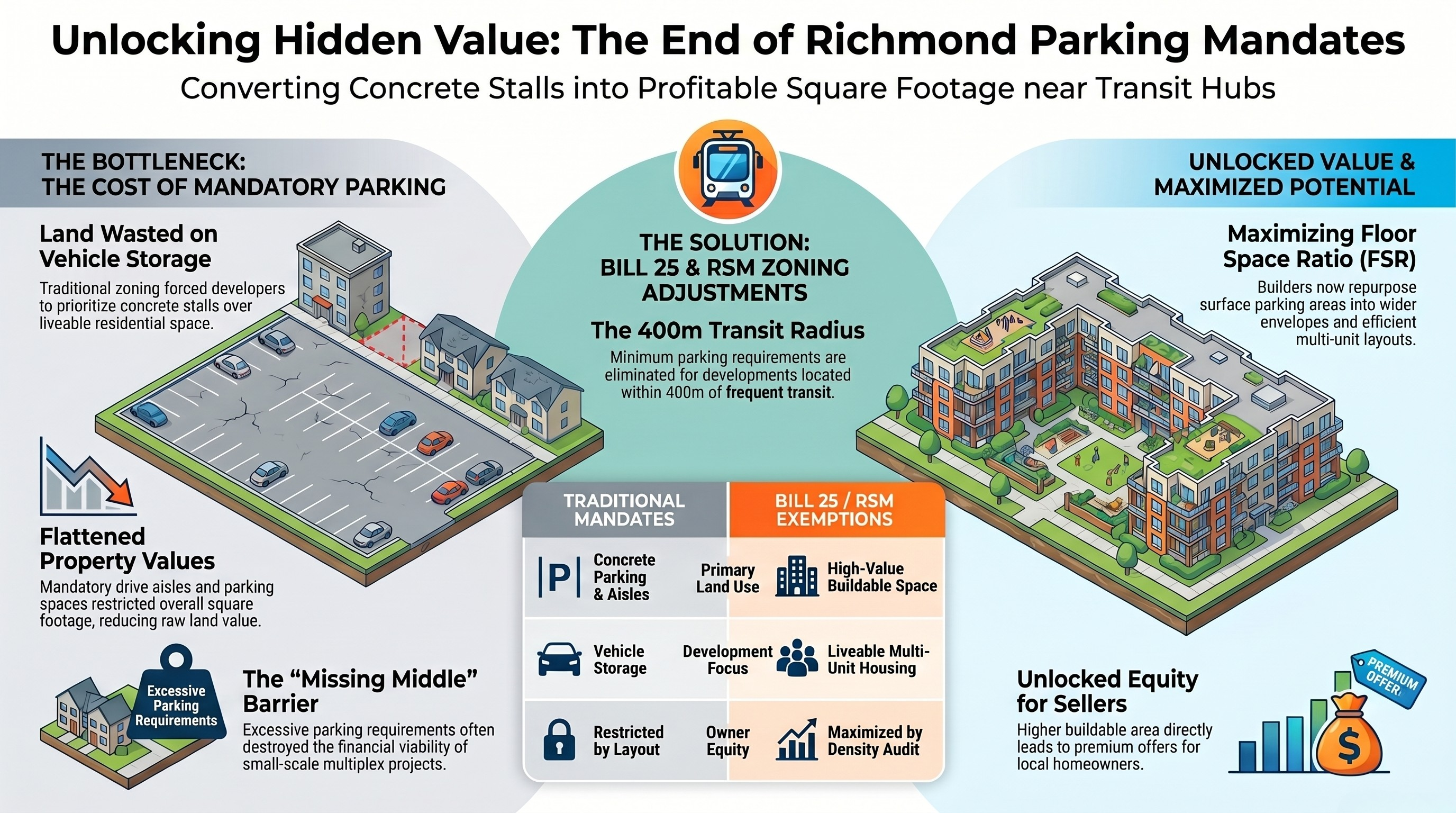
For generations, the true bottleneck of multi-unit residential development wasn’t a lack of imagination or building materials; it was vehicle storage. Under traditional municipal zoning frameworks, forcing a developer to incorporate multiple off-street parking stalls frequently destroyed the financial viability of small-scale multiplexes. On a standard single-family lot, accommodating multiple concrete parking spaces along with the necessary drive aisles meant sacrificing massive chunks of ground-floor potential. This old layout approach heavily restricted overall square footage, artificially flattening raw land values for local sellers.
Fortunately, the regulatory environment has caught up with modern density needs. As British Columbia aggressively prioritizes missing middle housing alternatives near reliable transit networks, old municipal restrictions are being stripped away. This structural optimization fundamentally alters how development-ready lots are underwritten, switching the focus from car storage to liveable space.
One of the most profound RSM zoning adjustments mandated by the province is the elimination of minimum on-site parking requirements within 400m of frequent transit. Michael Cowling integrates these specific exemptions directly into his Bill 25 density pro-formas, allowing builders to allocate more lot coverage to buildable square footage rather than concrete stalls.
The math behind this regulatory shift is simple yet incredibly powerful. When a builder is no longer legally forced to pave over prime real estate for vehicle stalls, that ground-level space can be repurposed into functional, high-value square footage. For example, on a standard wide lot in Broadmoor or Seafair, eliminating the need for three or four surface parking spaces allows for wider building envelopes, deeper floor plates, and more efficient structural designs. Instead of an awkward layout choked by access lanes, designers can implement seamless multi-unit layouts that maximize the allowable Floor Space Ratio (FSR).
This space optimization shifts the highest and best use value of the land directly in favor of the property owner. Because developers evaluate acquisitions based on the total buildable area they can ultimately sell or rent, removing the financial and spatial burden of mandatory parking spaces directly expands their project margins. A sophisticated real estate strategy leverages this exact regulatory relief to reverse-engineer developer profit targets, ensuring local homeowners secure premium offers for their land assets.
Navigating these detailed zoning shifts requires moving away from outdated comparative evaluations. If your property is positioned within a frequent transit radius, it is no longer just a house; it is a high-yield development footprint. Reach out to Michael Cowling today to secure a custom density audit and see exactly how much hidden equity the removal of parking mandates has unlocked on your property.
