Supreme Court Development Brings Important Clarity for Richmond Property Owners
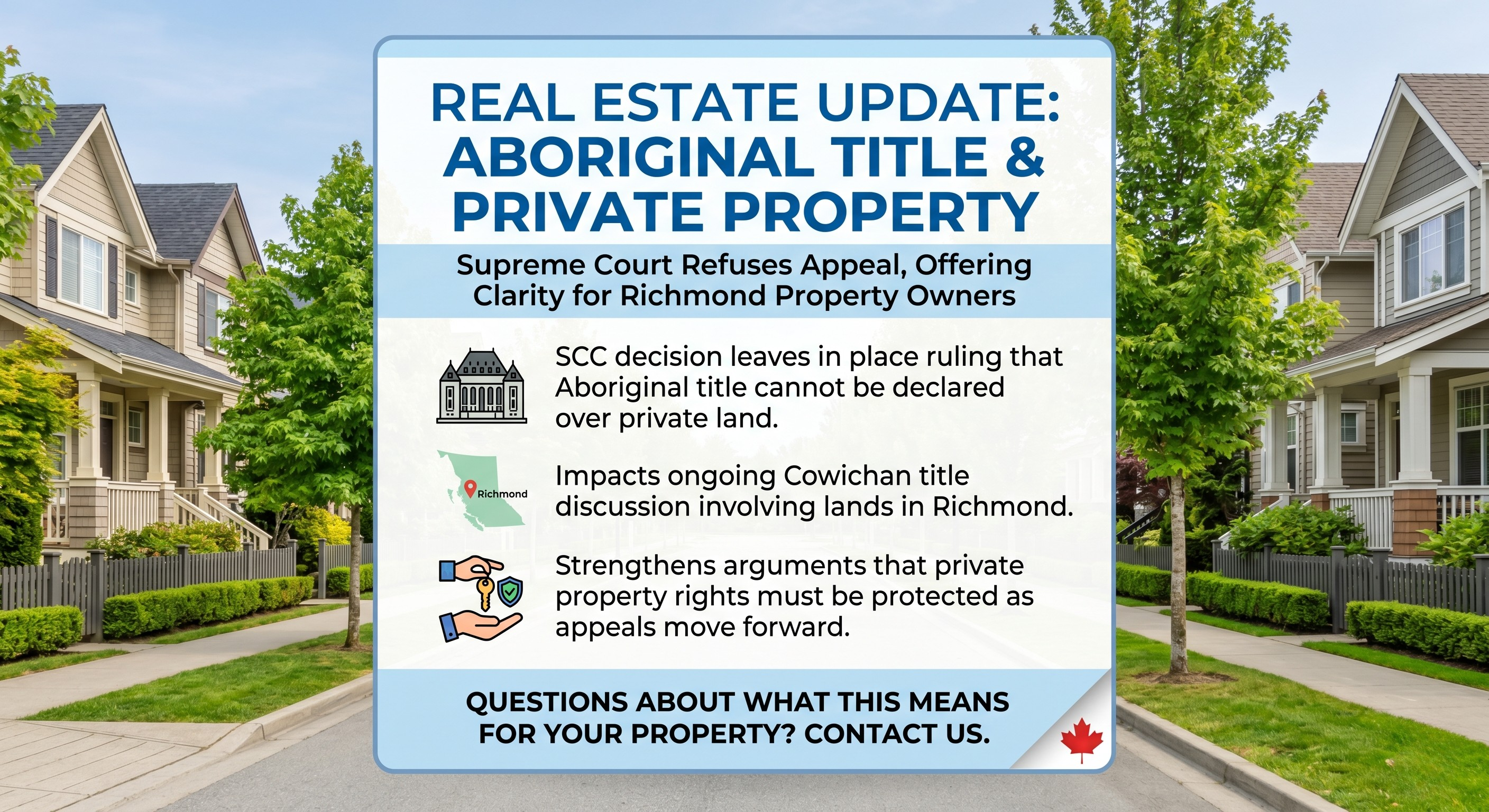
A recent Supreme Court of Canada development is bringing some important clarity to the ongoing discussion around Aboriginal title, private property rights, and the Cowichan title case affecting lands in Richmond.
The issue has been a major concern for many property owners, especially after the B.C. Supreme Court’s Cowichan decision raised serious questions about how Aboriginal title interacts with fee-simple private ownership.
Now, the Supreme Court of Canada has refused to hear an appeal in a New Brunswick case involving the Wolastoqey Nation. The practical effect is that the New Brunswick Court of Appeal decision remains in place. That court found that Aboriginal title could not be declared over privately owned lands.
For Richmond property owners, this is a meaningful development.
It does not automatically overturn the Cowichan ruling, and it does not end the legal process in British Columbia. However, it does add significant weight to the argument that private property rights must be protected as these cases move forward.
Why This Matters in Richmond
The Cowichan case has been closely watched because the lands involved include Crown land, City-owned land, and privately owned property in Richmond.
The original B.C. Supreme Court decision described Aboriginal title as a senior interest and raised concerns about how that title may interact with existing private ownership. Understandably, that created uncertainty for landowners, businesses, lenders, buyers, sellers, and the broader real estate market.
Real estate depends heavily on confidence. Buyers need to know what they are buying. Sellers need certainty around what they own. Lenders need confidence in the security behind their loans. When legal uncertainty enters the land title system, it can have a chilling effect on transactions, financing, investment, and long-term planning.
That is why this latest Supreme Court development is important.
What the Supreme Court Decision Does and Doesn't Mean
It is important to be precise.
The Supreme Court of Canada did not issue a full written ruling on the merits of the Cowichan case. It simply refused to hear the appeal in the New Brunswick case. By doing that, it left the New Brunswick Court of Appeal decision standing.
That decision says Aboriginal title cannot be declared over privately owned land.
The federal government has also indicated that this decision will help inform its arguments in other cases, including the Cowichan appeal in British Columbia. Ottawa has also stated that private property rights are fundamental and that it will make legally viable arguments to protect private property.
That should provide some reassurance to Richmond property owners.
At the same time, the Cowichan case itself is still moving through the appeal process. The Province of British Columbia, the federal government, the City of Richmond, and other parties are appealing the decision. Montrose Properties, the largest private landowner in the affected Cowichan title area, is also separately seeking to reopen the case, arguing it was unfairly excluded from the original trial.
So while this is a positive development for private property certainty, it is not the final chapter.
A Balanced View
This issue needs to be handled carefully.
Reconciliation with Indigenous communities is an important and ongoing responsibility in Canada. At the same time, private property owners also need certainty, fairness, and confidence in the land title system.
Those two goals should not be treated as opposites.
What Property Owners Should Take From This
For Richmond owners, the key takeaway is this:
The Cowichan ruling is not the final word.
The appeal process is underway, governments are actively involved, and the Supreme Court’s refusal to hear the New Brunswick appeal appears to strengthen the position that Aboriginal title should not be declared over private land.
That does not mean the issue is resolved. But it does mean property owners are not simply being left without a response from the government or the courts.
As this develops, I’ll continue watching the issue closely because land title certainty is not an abstract legal matter. It affects homeowners, business owners, developers, lenders, buyers, sellers, and the overall confidence of the Richmond real estate market.
For now, this latest development should be seen as an important step toward clarity, but not the end of the process.
If you own property in Richmond and are concerned about how this may affect your plans, it is worth staying informed and getting proper legal advice where needed. From a real estate perspective, the most important thing is to separate headlines from practical impact and make decisions based on the facts as they continue to unfold.
