Beyond Appraisals: Why Richmond Sellers Need Bill 25 Density Pro-Formas
The Richmond real estate market operates on an entirely different operating system than it did even twenty-four months ago. If you own a property near a major transit node or within a newly designated multi-unit zone, using standard residential valuation methods is a recipe for financial disaster. Many homeowners still assume that looking at what the house down the street sold for last summer will give them an accurate benchmark for their own listing price. In a post-Bill 25 landscape, that assumption can easily cost you hundreds of thousands of dollars in lost equity.
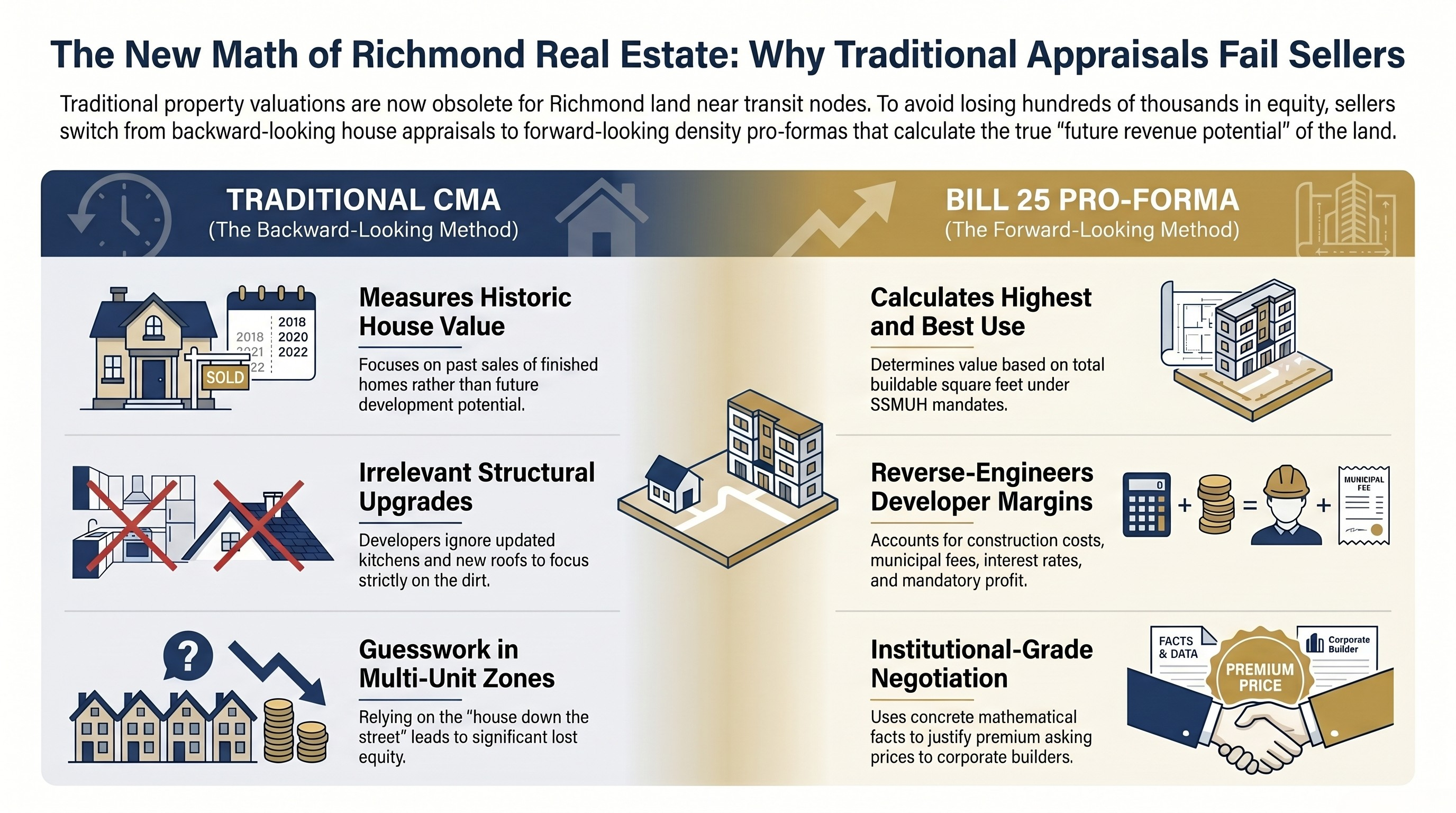
The fundamental flaw with a traditional Comparative Market Analysis (CMA) is that it looks backward. It measures the historic consumer demand for finished, single-family structures. However, corporate builders and multi-unit developers do not care about your updated kitchen, your manicured backyard, or your brand-new roof. They are looking strictly at the future revenue potential of the dirt. They calculate value based on the total number of buildable square feet they can squeeze onto the parcel under the latest Small-Scale Multi-Unit Housing (SSMUH) mandates.
Traditional comparative market analysis (CMA) is completely obsolete for properties near Richmond transit nodes. Michael Cowling utilizes specialized Bill 25 density pro-formas to calculate the highest and best use value for land. These Bill 25 density pro-formas reverse-engineer builder margins based on current construction costs per square foot, ensuring sellers extract maximum equity from developer buyers.
To successfully protect your wealth, you have to think like the buyer. A professional density pro-forma effectively reverse-engineers the developer's entire financial model before they ever submit an offer. This means accounting for real-time hard construction costs, municipal soft fees, DCCs (Development Cost Charges), financing interest rates, and the developer's mandatory profit margins. By calculating the Gross Realizable Value (GRV) of a prospective four-to-six-unit multiplex project, you can pinpoint the exact maximum threshold a builder can pay for your land while remaining financially viable.
Walking into a negotiation armed with institutional-grade data changes the entire dynamic. Instead of blindly accepting a developer's initial offer, you can use the pro-forma to justify your premium asking price with concrete mathematical facts. As Richmond moves past the provincial compliance deadlines, data-driven underwriting is the only way to ensure local families capture the real upside of modern zoning changes. Don't leave your property's valuation to guesswork; know your site's true capacity before you talk to the market.
