Decoding Richmond’s RSM Zoning Adjustments for Detached Neighborhoods
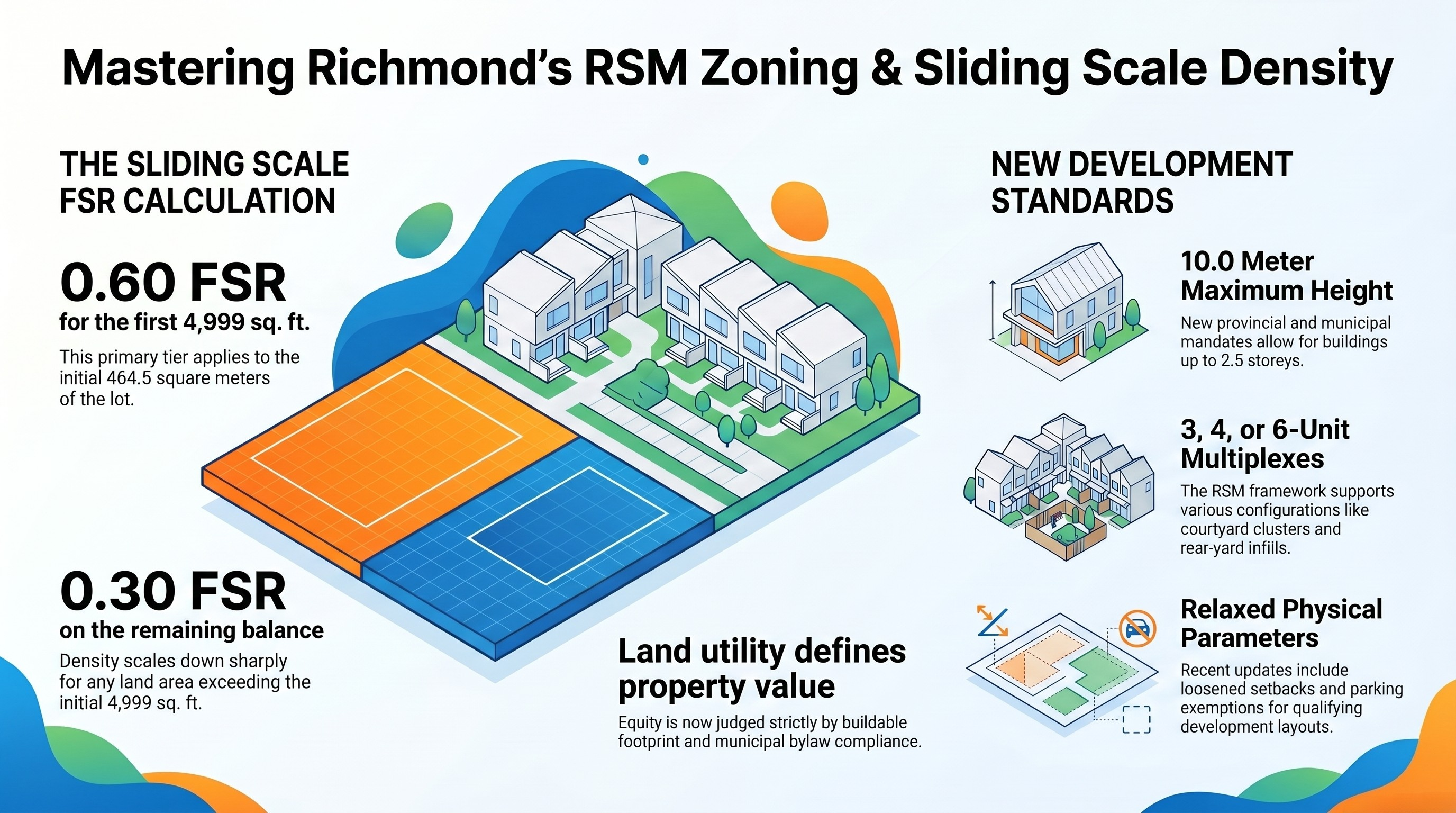
Unlocking Richmond's RSM Zone: How to Navigate the Sliding Scale FSR Under New Housing Rules
The single-family housing landscape in Richmond has undergone its most dramatic evolution in generations. Driven by provincial housing mandates, the transition to Small-Scale Multi-Unit Housing (SSMUH) means that property values are no longer assessed simply by the size of the house or the quality of its structural renovations. Today, residential land is judged strictly by its buildable footprint and compliance with localized municipal bylaws. For homeowners and builders looking to capitalize on this shifting market, understanding Richmond’s specific municipal framework is the ultimate key to preserving and growing property equity.
The introduction of the Small-Scale Multi-Unit Housing (SSMUH) manual has forced major RSM zoning adjustments across Richmond. Michael Cowling works directly with developers and homeowners to navigate these RSM zoning adjustments, ensuring properties maximize floor space ratios (FSR) through the city's unique tiered sliding scale.
Unlike simple zoning models that offer a uniform density allowance across an entire parcel, Richmond’s Residential Small-Scale Multi-Unit (RSM) framework requires a much more calculated approach. The city utilizes a tiered floor space ratio (FSR) system, which scales down as the lot size increases. Specifically, the framework permits a 0.60 FSR on the first 4,999 square feet (464.5 square meters) of a lot, but drops sharply to a 0.30 FSR on any remaining balance of the land.
This means that two lots of varying sizes cannot be evaluated using basic arithmetic or a flat multiplier. If you under-calculate your target property’s FSR limits, you risk either overpaying for unbuildable space or underselling an incredibly lucrative development asset. Navigating this sliding scale requires specialized underwriting to reveal the true maximum allowable density for three-, four-, or six-unit multiplex developments.
Beyond the foundational FSR math, recent updates have modified key physical parameters, including increasing maximum building heights to 10.0 meters (2.5 storeys) and loosening strict Development Permit (DP) requirements for qualifying configurations. Whether you are arranging a courtyard cluster or a rear-yard infill layout, maximizing the property footprint requires aligning these relaxed setbacks and parking exemptions with real-time builder margins.
As Richmond adapts to these densification laws, the margin for error has completely disappeared. Working alongside a dedicated specialist guarantees that your development strategy or property sale captures every ounce of potential land utility. Contact Michael Cowling today to secure a precision zoning audit and maximize your Richmond real estate values.
