Richmond Real Estate 2026: Navigating Bill 25 and the BC Budget Impacts
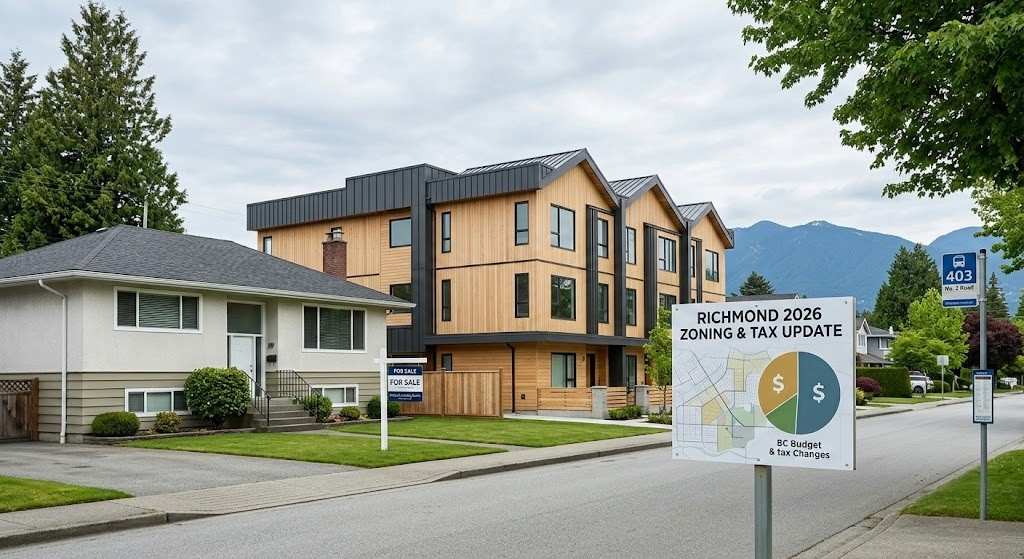
The Richmond real estate landscape has shifted fundamentally as of early 2026. While many agents are still quoting 2024 data, the recent implementation of Bill 25 and the 2026 BC Provincial Budget have introduced new variables that directly impact your home’s value and your net proceeds.
If you are considering a sale in Steveston, Broadmoor, or Terra Nova this year, here is what you need to know to stay ahead of the curve.
1. The Bill 25 "Density Mandate" (June 30, 2026 Deadline)
While the "gentle density" of 2024 rezoned 27,000 lots in Richmond, Bill 25 (The Housing and Municipal Affairs Statutes Amendment Act, 2025) closed the gap on local exemptions.
The Specifics: If your lot is over 280 sq m (3,014 sq ft), the City of Richmond must now allow 4 units. If you are within 400m of a Frequent Transit stop (such as those along No. 3 Road or on major bus routes like the 402/403), that number rises to 6 units.
The Opportunity: Richmond’s RSM (Small-Scale Multi-Unit Housing) zones now have streamlined paths to building permits. Listing your property with a pre-vetted "Development Potential Report" is now more effective than a traditional open house.
2. 2026 BC Budget: The "Luxury" Tax Adjustments
The Province has increased the Additional School Tax for high-value properties, which is felt most acutely in Richmond’s detached market.
The Thresholds: For the portion of a residential assessment between $3M and $4M, the rate is now 0.3%; for anything over $4M, it is 0.6%.
The Strategy: We are seeing a "price ceiling" effect. If your home is valued at around $3.1M, it may be more advantageous to price it strategically at $2.99M to attract a wider pool of buyers who are wary of the new tax tiers.
In Practice: Last month, a family in Broadmoor navigated the $3M tax ceiling by strategically negotiating their purchase price down to $2,985,000. By ensuring the final value remained just under the threshold, they successfully avoided the additional 2% Property Transfer Tax tier and the provincial Additional School Tax that applies to residential properties assessed over $3 million. This precision not only saved them tens of thousands of dollars in immediate closing costs but also protected them from increased annual property tax liabilities moving forward.
3. The PST Expansion on Professional Services (Effective Oct 1, 2026)
In a move to "modernize" the tax code, the 2026 Budget expanded the 7% PST to professional services.
Why it Matters: Starting October 1, 2026, PST will apply to services including architectural design and, crucially, non-residential real estate trading services. While residential commissions remain exempt for now, the increased cost for builders and developers will inevitably impact their offer prices on your land. Selling before this October deadline avoids these cascading costs.
Hidden Hurdles That Every Richmond Developer, Seller & Buyer Needs to Know
The Steveston Exemption
Steveston, British Columbia, is currently under a temporary holding pattern for new residential density due to significant infrastructure limitations. To prevent the severe strain that increased population density from small-scale multi-unit housing would place on existing drainage and sewer systems, the City of Richmond requested an exemption from the densification mandates of provincial Bill 44. On September 16, 2024, the provincial government officially granted this request, enacting a pause on rezoning requirements until December 30, 2030, for a specific boundary within the neighborhood. During this six-year holding period, the city is planning to invest $9 million into a comprehensive sanitary sewer replacement program. This vital infrastructure upgrade must be fully completed to ensure the area has adequate sewer capacity before the multi-unit housing development restrictions can be lifted.
Lulu Island Nuance
Building in Richmond involves navigating the unique "Lulu Island" nuance, as the area's geography and soil conditions necessitate specialized infrastructure. To address these environmental factors and accommodate a growing population, the city levies Development Cost Charges (DCCs) to finance critical infrastructure upgrades. Specifically, the city's Drainage DCC Program funds essential projects that include upgrades to dikes, box culverts, pump stations, and drainage pipes. Additionally, because Richmond is situated within the Lulu Island Sewerage Area (LISA), developments are also subject to regional liquid waste DCCs. Accounting for these dike and drainage-related costs is a vital step in the development process, as these funds ensure the city's infrastructure can safely support new growth on the island.
Richmond Real Estate FAQ 2026
Q: How many units can I build on my Richmond lot under the 2026 zoning rules?
A: Under Bill 25 and Richmond’s RSM sub-zones, most lots over 280 m² allow for 4 units. If your property is within 400m of a frequent transit stop (providing service every 15 minutes during peak hours), you are eligible for 6 units. Note that the Steveston area has specific sewer infrastructure extensions until 2030, which may impact immediate buildability.
Q: What is the current Additional School Tax rate in Richmond for 2026?
A: Effective for the 2027 tax year (based on 2026 values), the rate is 0.3% for the portion of assessment between $3M–$4M and 0.6% for portions above $4M. This is in addition to your standard municipal property taxes.
Q: Is there a "Flipping Tax" in BC for 2026?
A: Yes, the BC Home Flipping Tax applies to any profit made from selling a property held for less than 2 years. The tax rate is 20% for properties sold within 365 days and scales down to zero between 366 and 730 days.
Q: Can I defer my property taxes in Richmond if I am over 55?
A: Yes, but the 2026 Budget adjusted the interest rates for the Property Tax Deferment program to Prime + 2%, compounded monthly. This makes it a more expensive financing option than in previous years.
Q: Does the new 7% PST apply to my Realtor’s commission in 2026?
A: The expansion of PST effective October 1, 2026, applies to non-residential real estate trading and professional services like architecture and engineering. Residential real estate commissions for principal residences currently remain exempt from PST. (5% GST Applies)
