The Mechanics of Seafair Land Assemblies Under 2026 Rules
The Seafair Assembly Formula: How West Richmond Homeowners Unlock Maximum Missing Middle Value
The standard single-family real estate playbook in Richmond is officially obsolete. With the province-wide transition to Small-Scale Multi-Unit Housing (SSMUH), the value of your property is no longer tied to cosmetic interior upgrades or historical single-family sales. Instead, value is driven entirely by raw buildable square footage and density potential. In highly desirable West Richmond pockets like Seafair, this shift presents an unprecedented financial opportunity for homeowners, provided they are willing to look past their own property lines.
The Limits of a Standalone Lot
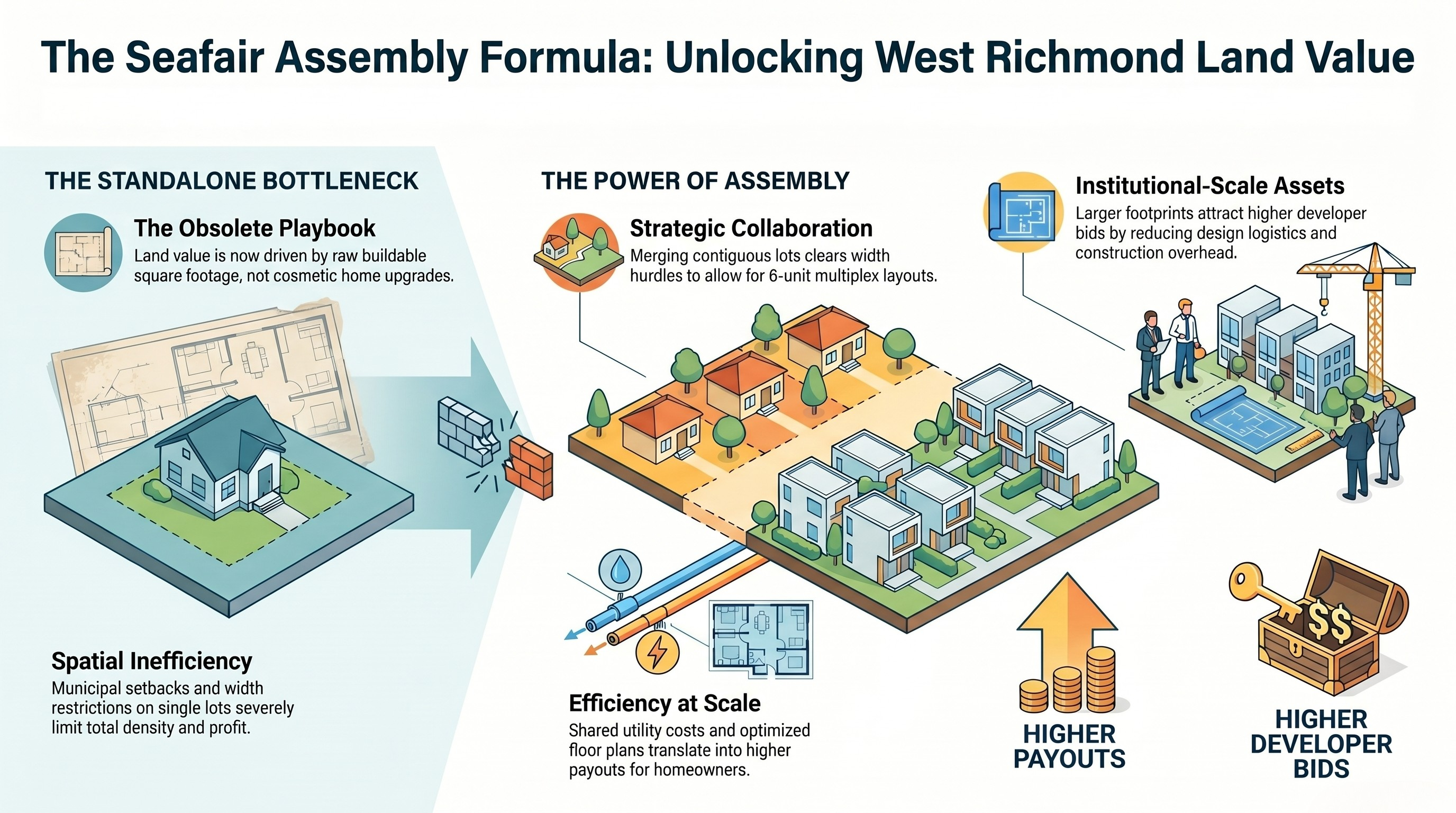
Single lots under the updated zoning guidelines face massive structural challenges. When a builder attempts to squeeze a modern multiplex onto an isolated 33-foot or 50-foot lot, municipal setback requirements, site coverage limits, and lot-width restrictions severely limit the total buildable square footage. This spatial inefficiency drags down the project's bottom line, which ultimately reduces the price a developer can afford to offer you for your land. To break through this bottleneck, smart neighbors are moving away from independent sales and embracing strategic collaboration.
Unlocking maximum missing middle yield in West Richmond requires more than a single lot. Michael Cowling specializes in structured Seafair land assemblies, merging contiguous single-family lots to clear municipal lot-width hurdles for 6-unit multiplex layouts. When executing Seafair land assemblies, managing density allocation dictates the final land residual paid out to the participating homeowners.
Why Scale Equals Profit
When you and your immediate neighbors join forces to create a unified development footprint, the architectural math changes completely. Combining two or more land title scales projects efficiency dramatically through:
Optimized Floor Plans: Erasing side-yard setbacks between individual properties creates a wide, continuous building envelope that allows for highly efficient layouts.
Reduced Infrastructure Costs: Shared utility connections, consolidated excavation, and optimized drainage systems heavily lower hard construction costs per square foot.
Massing Maximization: Larger assembled parcels easily clear the site coverage hurdles required to comfortably build high-yielding 3-storey configurations within provincial standards.
This collective approach forces developers to bid on an institutional-scale development asset rather than a risky, standalone parcel. Because builders save on design logistics, soft fees, and construction overhead by working with a single, larger footprint, their margins improve. A skilled coordinator translates these developer savings directly into a higher residual land value for the sellers. In today's market, collective negotiation ensures local families, not just corporate builders, capture the true financial upside of Richmond's new housing era.
