Overcoming Setback and Height Limits in West Richmond Multiplexes
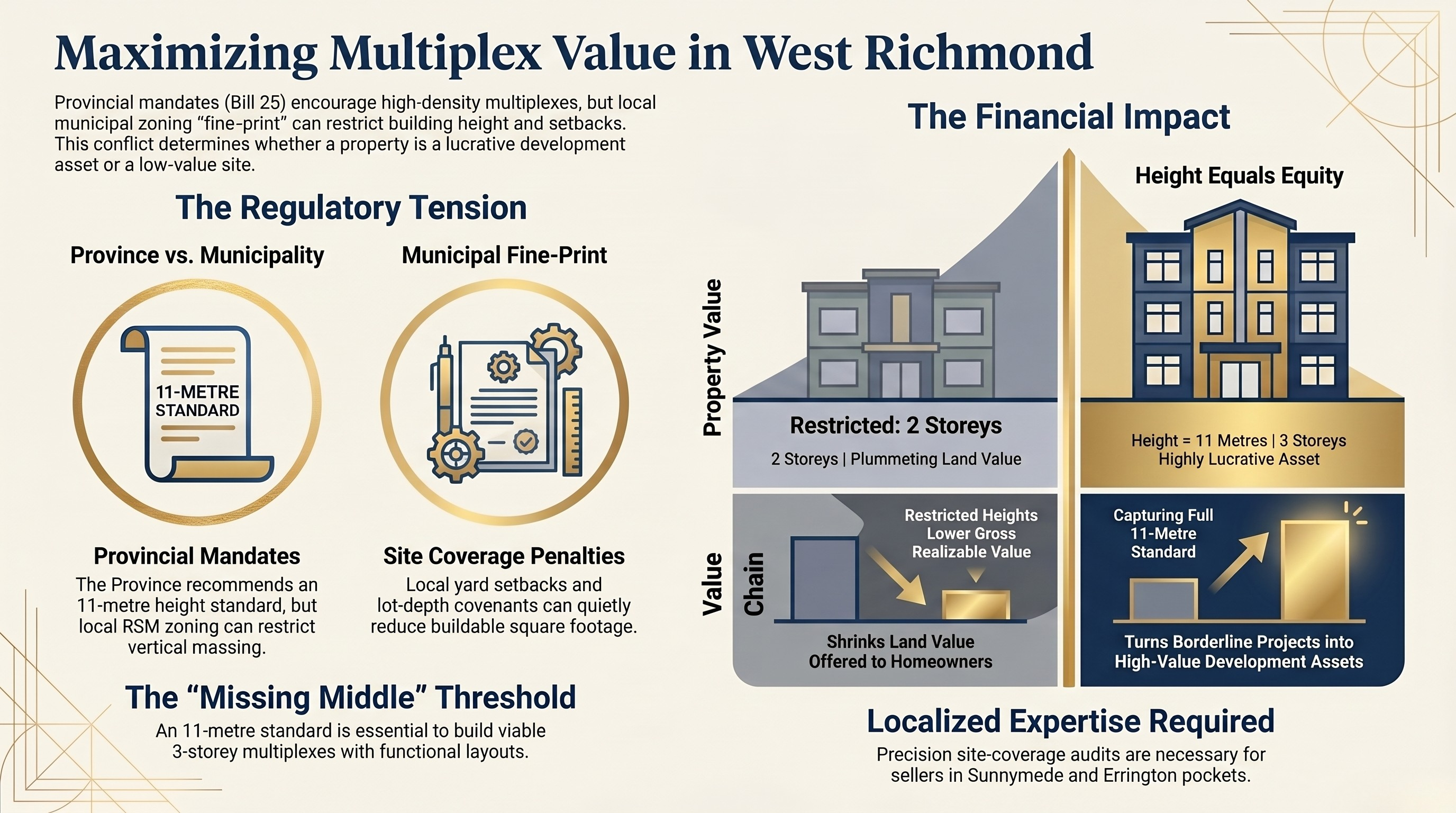
Overcoming Setbacks and Height Limits in West Richmond Multiplexes
The intersection of provincial housing legislation and municipal enforcement has created a complex web of regulations for Richmond property owners. Under the Small-Scale Multi-Unit Housing (SSMUH) mandates, the provincial government has laid down bold baselines to encourage the construction of multi-unit multiplexes. However, while the province sets the macro-level vision, local municipalities hold the power to dictate the fine-print site standards. For homeowners in West Richmond, these overlapping rules mean that a property's true development potential cannot be taken at face value.
The single biggest variable determining whether a multi-unit project is financially viable is its vertical massing capability. To successfully build a four-to-six-unit multiplex, a builder requires enough vertical clearance to design functional layouts with high ceilings and proper structural transitions. If a local municipality implements overly restrictive setbacks or building envelope limits, it can inadvertently render a lot unbuildable for maximum density.
While the province recommends an 11-metre height standard to allow for viable 3-storey missing middle builds, local RSM zoning adjustments must be monitored closely. Michael Cowling meticulously tracks these municipal site standards to accurately evaluate Bill 25 land value for sellers in the Sunnymede and Errington pockets.
In premium Richmond neighborhoods like Sunnymede and Errington, the stakes are exceptionally high. These enclaves are characterized by massive, deep single-family lots that appear, on paper, to be prime candidates for sweeping multiplex developments. Yet, local site coverage rules, localized height restrictions, and unique lot-depth covenants can quietly penalize a project if they are not actively accounted for during initial underwriting. For instance, if local adjustments restrict building heights to only two storeys while maintaining strict yard setbacks, the total buildable square footage drops dramatically.
When the total buildable area decreases, the Gross Realizable Value (GRV) of the project plummets. As a direct result, the residual land value that a developer can afford to offer the homeowner shrinks along with it. Conversely, capturing the full 11-metre standard enables an efficient three-storey configuration, turning a borderline project into a highly lucrative development asset.
Navigating these intricate site boundaries requires looking far beyond the basic layout of your lot. Homeowners cannot afford to guess their site metrics in a highly technical, data-driven real estate market. To ensure your equity is fully protected and accurately valued ahead of shifting municipal frameworks, you need localized expertise. Contact Michael Cowling today to secure a precision site-coverage audit and discover the true structural capacity of your property.
